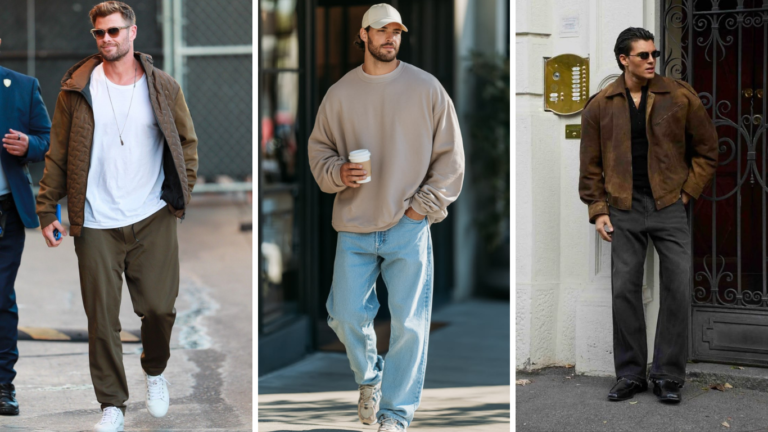
How to Build a Signature Style as a Man
Most men who say they “don’t have a style” actually have one already — it’s just unintentional, built from whatever was on sale or easiest to grab, rather than chosen.
A signature style isn’t about owning more clothes or following more trends; it’s about narrowing down what actually works for your body, lifestyle, and taste so that getting dressed becomes fast and consistent instead of a daily guessing game.
Building a signature style as a man means identifying a consistent set of fits, colors, and details that reflect your personality and repeating them deliberately, rather than dressing differently and randomly every day.
By the end of this guide, you’ll have a clear, step-by-step process for developing a personal style that looks intentional immediately and only gets sharper over time.
1. Audit What You Already Wear and Repeat
Before adding anything new, look at what you already reach for again and again — the shirt you rewear within the same week, the jacket you grab by default, the shoes that go with almost everything. This pattern already reveals the beginning of your personal style; you just haven’t noticed it because it wasn’t intentional.
Most men skip this step and try to build a style from scratch, which is slower and less accurate than starting from what’s already proven to work for their actual life and habits. The clothes you keep returning to tell you more about your real preferences than any style quiz or Pinterest board ever will, because they’ve survived real-world use, not just aspiration.
This audit also exposes gaps. If you notice you always reach for the same navy sweater because it’s the only thing that fits well through the shoulders, that’s a signal to buy more pieces cut the same way — not to keep buying random new silhouettes and hoping one sticks.
Similarly, if half your closet never gets worn, that’s not “style diversity,” that’s dead weight diluting a style you haven’t fully committed to yet. A useful way to do this audit is to simply track your outfits for a week or two and notice the pattern rather than the individual pieces — the goal isn’t a single “best” item but a recurring shape, color, or fit that shows up regardless of what else you’re wearing that day.
Once you’ve identified those recurring anchors, treat them as your baseline rather than an accident. Most men never take this step because they assume style has to be manufactured from outside inspiration rather than observed from their own existing habits, but the truth is that your closet has already been quietly voting on what works for years — you just haven’t been counting the votes.
2. Identify Your Body’s Proportions, Not Just Your Size
A signature style has to work with your actual proportions — torso-to-leg ratio, shoulder width, height — because clothes that fight your natural proportions will never look as intentional as clothes that work with them, regardless of trend or price.
This is a different exercise than knowing your size; two men can both wear a size 40 jacket and need completely different cuts because one has a longer torso and the other has broader shoulders. Skipping this step is why so many men buy pieces that look great on a hanger or on a model but never quite work on them.
Understanding proportion also helps you make faster decisions when shopping, because you stop being swayed by how something looks on someone else and start evaluating it against what you already know about your own frame. This single shift — from “does this look good” to “does this look good on my proportions” — is one of the fastest ways to raise the average quality of everything you own.
Proportion awareness also protects you from chasing trends that were never designed with your body in mind. A cropped jacket or a low-rise trouser might dominate a given season’s runway coverage, but if your torso-to-leg ratio doesn’t suit that silhouette, wearing it will always look like a compromise rather than a style choice. Once you know your proportions, you can adapt any trend to work for you instead of adopting it wholesale and hoping for the best.
3. Pick a Core Color Palette and Stay Disciplined
A signature style almost always has a recognizable color story — think of how certain men are associated with navy and camel, or charcoal and white, rather than a rotating rainbow of unrelated colors. Limiting your palette to four or five core colors that complement each other and suit your skin undertone makes every piece in your closet interchangeable, which is what makes a wardrobe feel curated rather than random. It also makes shopping dramatically easier, because you’re no longer evaluating each item in isolation — you’re asking whether it fits into a system you’ve already built.
This doesn’t mean never wearing color outside the palette; it means treating your core palette as the default and anything outside it as the exception, used sparingly and intentionally rather than as often as your defaults. Over time, a disciplined palette becomes part of how people recognize your style even before they notice specific pieces.
The discipline matters more than the specific colors you choose. A palette built around navy, charcoal, and white will work for one man just as well as a palette built around olive, tan, and cream works for another, provided each man sticks to it consistently. The mistake isn’t picking the “wrong” colors — it’s picking a new, unrelated color every time you shop, which prevents any palette from ever solidifying into something recognizable.
4. Choose Two or Three Style Reference Points
Every man with a recognizable style has reference points, whether he’s conscious of them or not — a decade, a figure, a subculture, or an aesthetic tradition he keeps returning to for inspiration. Choosing two or three intentionally (rather than absorbing whatever’s trending on social media that week) gives your style a throughline and a set of principles to fall back on when you’re unsure about a purchase. Reference points act as a filter: when you’re deciding between two jackets, you can ask which one better reflects the aesthetic you’re actually building toward.
This doesn’t mean copying an era or a person outright — it means extracting the underlying principles (proportion, formality level, color sensibility) and applying them to how you actually live. A signature style is really a translation of inspiration into something wearable and personal, not a costume, and the men who dress well most consistently tend to be the ones who’ve done this translation work deliberately rather than absorbing influences passively.
Blending two or three reference points, rather than committing to just one, is usually what makes a style feel personal instead of derivative. A single reference point risks looking like a re-creation; combining a couple of distinct influences — say, a classic tailoring tradition and a more relaxed, modern casual sensibility — produces something that reads as genuinely yours because the exact combination is unlikely to be duplicated by anyone else.
5. Build Around Fit, Not Just Pieces
A signature style is far more about how clothes fit than what specific pieces you own — the same basic wardrobe (a few shirts, trousers, jackets, and shoes) looks completely different on two men depending on whether it’s tailored to their actual proportions. This is why some men look consistently sharp even in a small rotation of simple pieces, while others look inconsistent despite owning far more clothing. Fit is also what makes a style read as “yours,” because off-the-rack sizing is generic by design and tailoring is the process that personalizes it.
Treating tailoring as a core part of your style-building process, not an occasional afterthought, means budgeting time and money for it whenever you buy something new. A relationship with a good tailor is arguably a bigger style asset than any single piece of clothing you could buy, since it’s the resource that turns every future purchase into something that actually fits your frame rather than a generic approximation of it.
Building this habit early also compounds over time. Once you have a tailor who understands your proportions and preferences, every new piece you bring in gets adjusted faster and more accurately, which means your wardrobe as a whole starts to fit more consistently the longer you maintain that relationship — something that’s impossible to replicate by buying off-the-rack alone, no matter how carefully you shop.
Read also: 10 Fashion Mistakes That Are Aging You (And How to Fix Them)
6. Develop One or Two Signature Details
Small, repeated details are often what people actually register as “your style” even more than big silhouette choices — a specific way you roll your sleeves, a particular kind of watch you always wear, a signature sock color, or a consistent way you fold a pocket square.
These details are low-cost and low-risk ways to build recognizability into your look without requiring an entirely new wardrobe. They also give your style a personal signature that can’t be easily replicated by someone just copying your general aesthetic.
The key is repetition — a detail only becomes signature once you’ve worn it consistently enough that people start to associate it with you specifically.
Scattering many small quirks across different outfits dilutes this effect; concentrating on one or two makes them stick, since the brain recognizes patterns far more easily than one-off novelties.
Choosing which detail to commit to is less important than actually committing. A rolled cuff, a specific sock choice, or a consistent way of wearing a watch will all work equally well as a signature, provided you repeat it enough that it stops looking like a coincidence and starts looking like a decision.
This is one of the lowest-effort, highest-impact steps in the entire process, because it requires no new wardrobe investment — only consistency in how you wear what you already own.
7. Edit Down to a Working Wardrobe
A signature style is easier to maintain with fewer, more coordinated pieces than with a large, disconnected closet, because a smaller wardrobe forces everything in it to actually work together.
This is the capsule wardrobe principle applied specifically to style-building: the fewer unrelated pieces you own, the less likely you are to put together an outfit that falls outside your established look.
Editing is often more valuable than adding at this stage, because it removes the pieces that don’t fit your palette, proportions, or reference points and clarifies what’s actually left.
This step is uncomfortable for a lot of men because it means letting go of pieces that were expensive or sentimental but don’t actually serve the style they’re building. A smaller, coherent wardrobe will always outperform a larger, inconsistent one when it comes to looking put-together on a daily basis, simply because fewer variables mean fewer opportunities for an outfit to fall outside your established look.
The payoff for this discomfort shows up almost immediately in how much easier mornings become. When every piece in your closet is already compatible with every other piece, getting dressed stops being a creative decision made from scratch each day and becomes closer to selecting from a pre-approved set of combinations — which is exactly the kind of consistency that makes a style feel signature rather than accidental.
8. Revisit and Refine Every Season
A signature style isn’t a fixed, permanent decision — it’s a system you refine over time as your body, lifestyle, and taste evolve, which is different from constantly changing direction based on trends. Revisiting your style choices every season lets you make small adjustments (updating a proportion, retiring a piece that’s worn out, testing a new but compatible color) without losing the overall coherence you’ve built. Men with the most recognizable personal styles tend to describe them as having evolved gradually over years, not arrived at all at once.
This ongoing refinement is what separates a signature style from a phase. A phase gets abandoned entirely once the next trend appears; a signature style absorbs small updates while keeping its core principles intact.
Example: At the start of each season, review your wardrobe against the palette, proportions, and reference points you defined earlier, and ask what’s worn out, what no longer fits your body, and what one thing could be added to keep the look feeling current without abandoning what’s already working.
Quick Summary
| # | Step | Core Idea |
|---|---|---|
| 1 | Audit what you repeat | Your real style is already visible in your habits |
| 2 | Know your proportions | Fit follows your frame, not your size label |
| 3 | Pick a core color palette | Limits build coherence and ease |
| 4 | Choose 2–3 reference points | Gives your style a filter and a throughline |
| 5 | Build around fit | Tailoring personalizes generic sizing |
| 6 | Develop signature details | Small repeated choices become recognizable |
| 7 | Edit down your wardrobe | Fewer, coordinated pieces mix better |
| 8 | Revisit every season | Style should evolve, not stay static or trend-chase |
FAQs
How long does it take to build a signature style?
Quick answer: most men see a noticeable shift within one to two seasons. Building a signature style is a gradual process of auditing, narrowing, and refining rather than a single shopping trip, so expect steady improvement over several months rather than an overnight transformation.
Do I need to spend a lot of money to build a signature style?
No — a signature style is more about consistency in fit, color, and proportion than about spending more money. A smaller, well-edited wardrobe of mid-priced pieces that fit correctly will look more intentional than an expensive but disorganized closet.
What if my style doesn’t match any specific era or reference point?
That’s normal, and reference points are meant to be blended rather than copied exactly — most personal styles combine two or three influences into something new rather than replicating one look wholesale. The goal is extracting principles you like, not recreating a costume.
Is a signature style the same as always wearing the same outfit?
No — a signature style is a consistent system of colors, fits, and details that lets you vary outfits while still looking recognizably like “you.” It’s about coherence across variety, not repeating one identical outfit every day.
Read also: